Blockbuster - Games & Social
- 4.5
- Rating
- 100.00K
- Installs
- Free
- Price

 Analysis by App-foxy
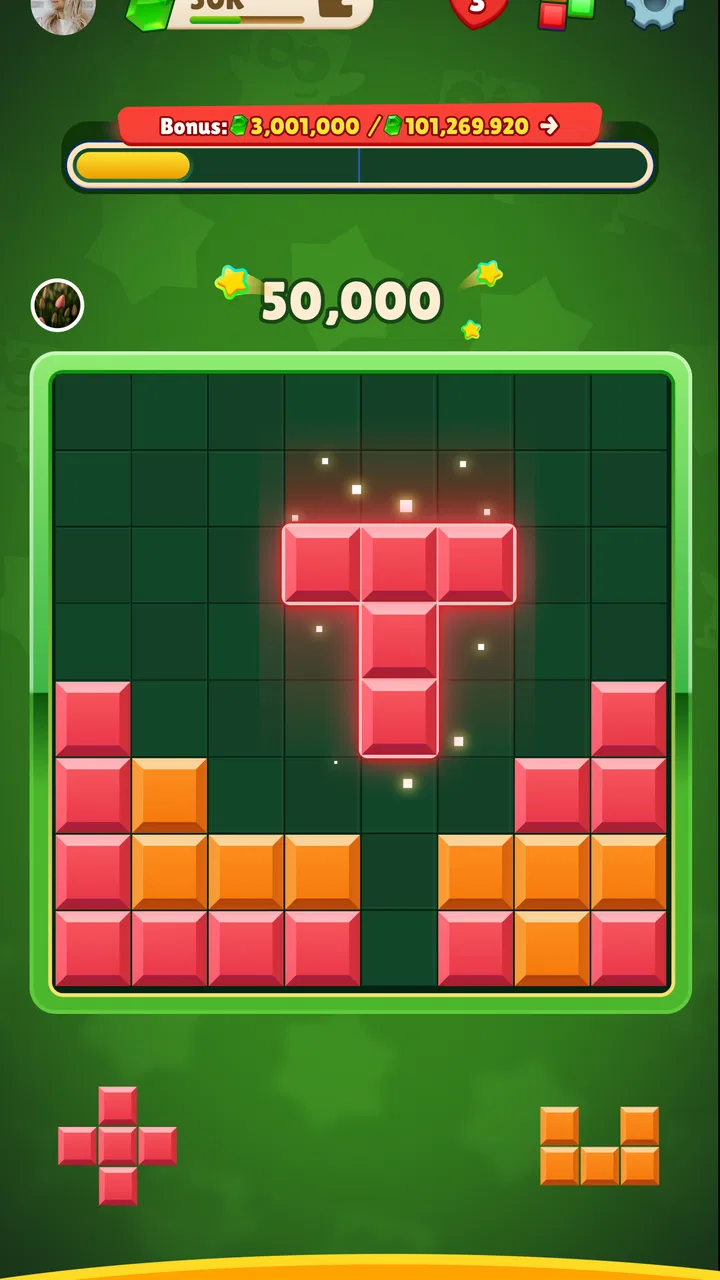
I approached Blockbuster - Games & Social as a puzzle game first and a social competition second. That order matters. Its central appeal is the way a familiar block puzzle becomes more demanding when pieces can be moved, flipped, and rotated, while global competition and chat add a more public layer to each session. I found it easiest to enjoy when I treated the board as a small problem to solve rather than as a race I had to win.
Developed by Blockbuster Group, this free game sits in the puzzle category and is suitable for Everyone. It runs on Android devices using version 5.0 or later, so compatibility should be comfortable for many older phones as well as newer ones. The current version is 1.0.2, and its early reception is encouraging: it holds a 4.5 average from around 2,900 ratings, with more than 100,000 installs. Those figures suggest a healthy starting audience, although they do not tell me whether the competitive community will remain equally active over time.
How the puzzle feels after the first few sessions
The basic idea is immediately readable, but the extra movement options change the way I think. In a conventional block puzzle, the shape and orientation of a piece often dictate the decision. Here, flipping and rotating give me more control, yet that control creates more responsibility. A piece that appears awkward at first may become the key to opening a useful space after a turn or two.
You May Also Like

 Blood Strike: 2.5 Anniversary
Blood Strike’s Loadouts Turn Every Drop Into a Tactical Gamble
A close look at Blood Strike’s custom loadouts: how fast access to signature weapons reshapes its battle royale rhythm, rewards preparation, and narrows the gap between fights.

 Pandora - Music & Podcasts
Pandora’s Music Is Easy to Start, but Harder to Recover
Pandora’s strength is its low-effort path from a seed to a station. Its weak spot is how much confidence it asks you to place in connection, setup, and quiet recovery.

 8 Ball Pool
 Is Built on Rivalries, Rematches, and Routine
A close look at the rivalries, rematches, shared routines, and unanswered safety questions that turn a quick pool match into a persistent mobile community.

 Samsung Music
’s Quiet Strength Is Playing What You Already Own
Its reach comes less from spectacle than from dependable access to a personal library. That simplicity is both the app’s strongest retention engine and its ceiling.

 AccuWeather: Weather Radar
AccuWeather Review: A Quick, Clear Forecast for Everyday Decisions
For everyday plans, the best forecast is the one you can understand quickly. AccuWeather makes rain timing, radar, and local conditions easy to act on, with a few trade-offs.

 Hill Climb Racing
Why Hill Climb Racing Still Turns Crashes Into One More Run
A tiny car, a bumpy hill and one more upgrade: Hill Climb Racing keeps resurfacing because its simple chaos makes every near-miss feel personal.
More From Our News Desk
View All News


I quickly learned not to fill the most obvious gap automatically. The better question is what the board will look like after the next placement. A compact arrangement can be more valuable than a quick clear because it preserves flexibility. I also found that rotating a piece before mentally committing to a position helped me spot solutions that were easy to miss when I focused only on its default orientation.
That makes this a good fit for short breaks. I can play a few turns while waiting for an appointment, then stop without needing a long uninterrupted session. At the same time, the options are deep enough to reward concentration. A player who enjoys spatial reasoning will probably get more from it than someone looking for a completely passive time-killer.
The social framing gives the puzzle a different mood from a private offline board. Competing globally can make an otherwise ordinary placement feel meaningful, and chat can make the game feel less isolated. I would still recommend learning the board on my own terms before paying attention to rankings or conversation. Early mistakes are easier to understand when I am not also worrying about how they look to other players.
A practical routine for improving without overspending
My most useful routine was to separate observation from action. Before placing anything, I checked the available spaces, considered every orientation, and looked for a move that kept at least two future options open. This sounds slower, but it reduced the number of desperate corrections later. In a game built around rearranging pieces, the strongest move is often the one that protects flexibility rather than the one that produces the most immediate progress.
I also recommend using the social side selectively. Chat can be enjoyable when I want a shared atmosphere, but it is not necessary for every puzzle session. If I am tired or distracted, I get more value by concentrating on the board and returning to the competitive layer when I am in the mood. That separation is especially helpful for younger players, since the Everyone rating describes the content category but does not replace sensible supervision of social interaction.
Another small habit is to pause before using a tempting placement near the edge of the board. Edge spaces can look safe because they feel contained, but they may leave awkward gaps that are difficult to fill with later shapes. I had better results when I treated corners and edges as resources rather than automatic dumping grounds. This is the kind of lesson that does not appear in a short store summary but becomes important once the early novelty wears off.
Where progress can start to feel pressuring
The global competition changes the meaning of progress. In a purely personal puzzle, a good board is satisfying even if nobody else sees it. Here, the presence of other players can make me compare results, return more often, or feel that a session was unsuccessful unless it produced a strong showing. That pressure is not necessarily harmful, but it is worth recognizing before the competitive layer becomes the reason I keep playing.
The game is free to download, while in-app purchases range from $0.99 to $99.99 per item. That is an unusually broad spending range, and it is the most important practical detail for anyone deciding how to approach the game. I can begin without paying, but I would set a personal limit before exploring optional purchases. A low-cost experiment is very different from allowing a large purchase to become an impulsive response to a disappointing result.
I would not assume that spending automatically equals better puzzle judgment. The core challenge still depends on recognizing shapes, planning space, and choosing when to preserve options. If a purchase helps someone enjoy the game, that is a personal choice; it should not be confused with learning the underlying board. I prefer to establish whether the basic loop is enjoyable first, then decide whether any paid item genuinely adds value for my own play style.
For families, the purchase range makes device-level safeguards worth considering. The age rating is Everyone, but a child may not evaluate a high-priced item in the same way an adult does. I would explain that free access does not mean every in-game option is free, and I would avoid handing over a payment-enabled device without clear boundaries. This is a practical trust issue, not a criticism of the puzzle itself.
What competition adds—and what it cannot prove
The global element gives the game a reason to revisit familiar mechanics. A board that feels solved in isolation can become a test of consistency when I compare my performance with a wider player base. That makes careful planning more rewarding, especially for people who enjoy improving a personal approach rather than simply completing a level.
At the same time, a ranking or social result does not by itself prove that competition is perfectly even. The presence of purchases, the way scores are calculated, and the rules governing any competitive format all matter. I would avoid treating a strong position as proof of superior skill until I understood how the game handles those factors. The responsible conclusion is narrower: the game presents a competitive puzzle setting, but fairness should be judged by the actual rules encountered in play.
That distinction is important because the usual alternatives divide the experience differently. A traditional offline block puzzle is often better when I want quiet practice with no social pressure and no concern about global comparison. A competitive online puzzle can be more motivating when I want a reason to return and a sense of shared activity. Blockbuster - Games & Social aims for the middle ground, combining flexible block manipulation with competition and chat. Its advantage is variety; its trade-off is that the experience may feel less calm than a private puzzle.
I would choose this game over a basic offline alternative when I want my puzzle sessions to feel connected to a wider community. I would choose the simpler option when I want predictable relaxation, fewer distractions, or a clearly bounded spending environment. Neither choice is universally better. The right decision depends on whether the social layer improves the puzzle for me or merely adds noise around it.
Questions I would settle before making it a daily game
The first question is whether I need to pay to enjoy it. I would start with the free version and spend time learning the movement, flipping, and rotation mechanics before considering an in-app purchase. Since individual items can cost from $0.99 to $99.99, I would not treat the game as automatically low-cost simply because installation is free. My recommendation is to regard payment as optional until the basic puzzle loop has earned a place in my routine.
The second question is whether it works for a casual player. Yes, it can, provided the player is comfortable with spatial planning. The game does not need to be approached as a serious tournament activity. A few thoughtful placements can make a short session worthwhile, and the social features can remain secondary. Someone who dislikes rotating shapes or planning several moves ahead may find the apparent freedom more frustrating than entertaining.
The third question is whether the social features are essential. They are part of the identity of the game, but I would not make chat or global competition the only reason to install it. The puzzle mechanics need to stand on their own, because social activity depends on personal preference and on the quality of the community available at the time. I would try the board first, then decide how much of the social side I actually want.
The fourth question concerns device age. The minimum requirement of Android 5.0 makes the technical entry point relatively broad, although real-world comfort can still depend on the individual phone. I would keep expectations sensible on very old hardware and make sure the game feels responsive before committing to longer sessions. Compatibility is one thing; enjoyable handling during precise placements is another.
Finally, I would ask whether the current version feels mature enough for my needs. Version 1.0.2 indicates an early stage, and the install base is already above 100,000, which gives the game a meaningful starting point. Still, a newer title can evolve as players identify rough edges and the developer responds. I would enjoy what is available now while keeping my judgment focused on the actual experience rather than assuming future additions or changes.
My trust verdict on the spending model
My view is cautiously positive. The free entry point makes it reasonable to test the puzzle without committing money, and the mechanics offer more thought than a simple place-and-clear loop because orientation and arrangement matter. The broad purchase range, however, means I would approach the store carefully. I would never spend to chase a disappointing competitive result, and I would use purchase controls when sharing the device with a child.
I also appreciate that the game can be evaluated in stages. First, I can decide whether moving, flipping, and rotating pieces feels satisfying. Next, I can see whether global competition motivates me or distracts me. Only after those answers are clear would I consider whether chat and optional purchases belong in my routine. That staged approach keeps the decision based on enjoyment rather than pressure.
My strongest recommendation is to treat the puzzle as the product and the spending as a choice, not as a requirement. If the board itself keeps me curious, the free starting point is worthwhile. If I mainly want a quiet, offline experience with no social comparison, a conventional puzzle alternative may suit me better. If I enjoy spatial challenges and like having a competitive community around them, Blockbuster - Games & Social has a convincing reason to stay installed.
In the end, I see it as a promising puzzle game for deliberate players rather than a mindless filler app. Its flexible piece handling creates genuine decisions, while the global and chat elements give those decisions a social context. I would recommend it to a friend who enjoys experimenting with board space and can keep optional purchases in perspective. I would skip it for someone who wants absolute simplicity, dislikes online interaction, or is likely to confuse a free download with an unlimited free experience.
FAQs for Blockbuster - Games & Social
01What is Blockbuster - Games & Social?
Blockbuster - Games & Social is a dynamic app offering a blend of gaming and social networking features. Users can play a variety of games while connecting with friends and other gamers globally. The app provides a platform for sharing scores, achievements, and engaging in real-time chats, making it both entertaining and interactive.
02Is Blockbuster - Games & Social free to use?
Yes, Blockbuster - Games & Social is free to download and offers a range of free games. However, the app does include in-app purchases for additional features and content. These purchases can enhance the gaming experience by unlocking premium games, removing ads, or providing extra lives or boosts within games.
03What types of games are available on Blockbuster?
Blockbuster offers a wide variety of games across different genres, including puzzles, action, strategy, and arcade games. This diversity ensures that there is something for every type of gamer, whether you enjoy quick, casual games or more in-depth challenges. The app continuously updates its game library to keep users engaged.
04How does the social feature work in Blockbuster?
The social feature in Blockbuster allows users to connect with friends and other players around the world. You can add friends, join gaming groups, and participate in leaderboards. The app facilitates real-time chat and sharing of game achievements, creating a community feel and enhancing the overall user experience.
05Is Blockbuster - Games & Social safe for children?
Blockbuster - Games & Social is designed to be family-friendly, with many games suitable for children. However, parents should monitor in-app interactions and ensure appropriate privacy settings are in place. The app includes parental controls to restrict certain features, making it safer for younger users.
Pros
- Diverse game library with frequent updates.
- Integrated social features enhance interaction.
- User-friendly interface for easy navigation.
- Offline mode available for select games.
- Customizable player profiles and avatars.
Cons
- Requires stable internet for most features.
- In-app purchases can be costly.
- Occasional ads disrupt gameplay.
- Limited parental controls for younger users.
- Some games have steep learning curves.

Blockbuster - Games & Social
Gallery